
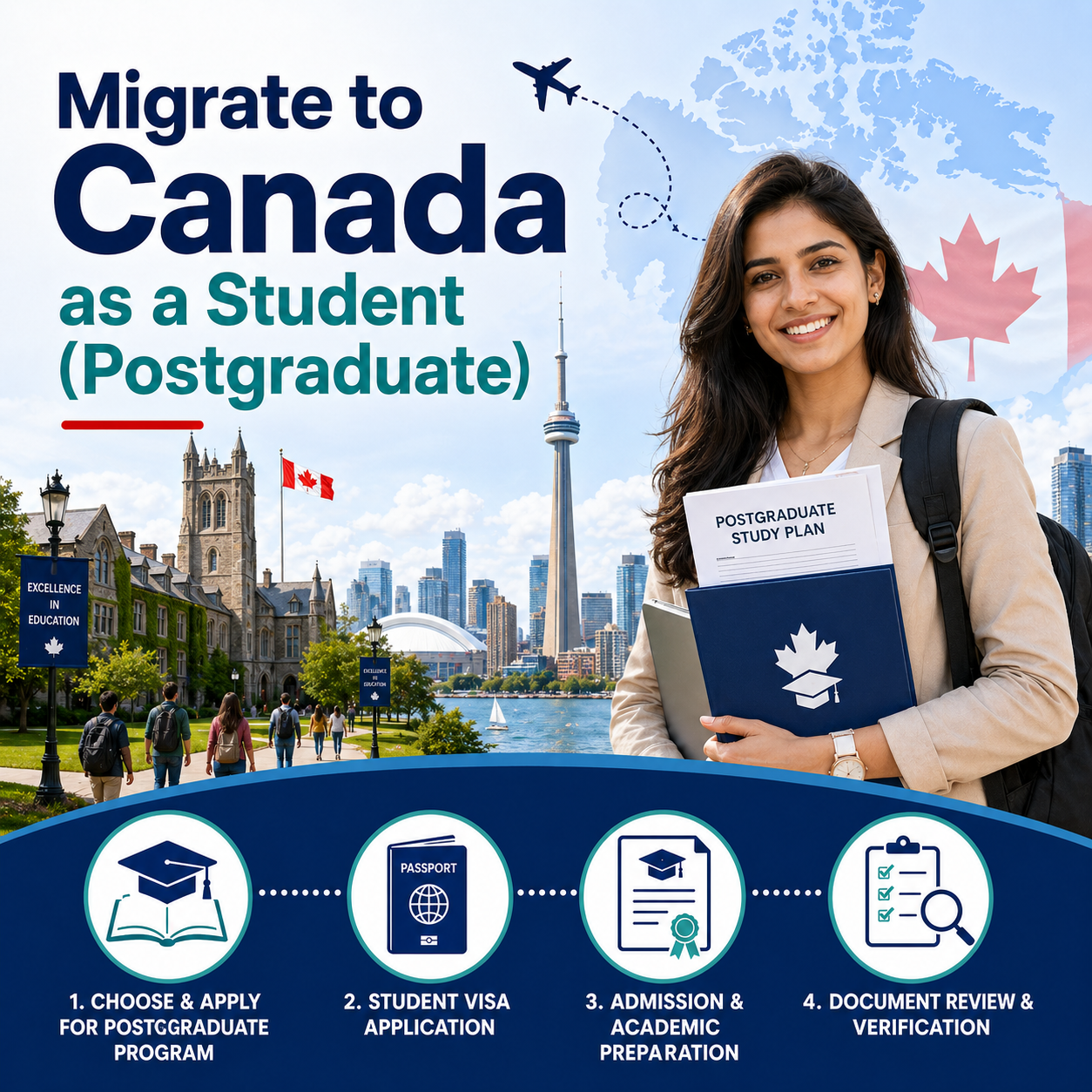
Migrate to Canada as a Student (Postgraduate)
This course helps postgraduate students plan migration to Canada with confidence through practical structured expert guidance. It covers admission planning, visa requirements, documents, timelines, costs, accommodation, compliance, and arrival preparation. Learners understand key study pathways, application steps, common mistakes, and settlement essentials, enabling them to organise evidence, reduce delays, and make informed decisions before starting their international education journey abroad.
$69.00
Migrate to Canada as a Student — Postgraduate Pathway
A practical, step-by-step guidance product for graduates who want to study a master’s degree, postgraduate diploma, graduate certificate, MBA, professional programme, research master’s, or PhD in Canada — with clear support on school selection, DLI checks, study permit preparation, financial evidence, PAL/TAL awareness, PGWP planning, work rights, family considerations, and long-term career strategy.
Important: Do not wait until admission deadlines, study permit processing, PAL/TAL timing, scholarship windows, or travel dates are close. Postgraduate study in Canada may require programme research, DLI and PGWP checks, academic documents, proof of funds, study-plan preparation, biometrics, medicals where required, family planning, and post-study strategy. Starting late can put your intake, money, and future options at risk.
Canada can be a powerful postgraduate destination — but the wrong programme choice can weaken your entire plan.
Many graduates choose Canada for internationally recognised education, multicultural cities, practical learning, research opportunities, work-right options, and possible post-graduation pathways. But postgraduate migration planning is not just about getting an offer letter.
You need to understand whether your institution is a DLI, whether your programme aligns with your career goals, whether your study plan is credible, whether your finances are strong, how PAL/TAL rules may affect you, and how PGWP planning connects with your long-term future. This guidance helps you move with structure instead of guesswork.
Postgraduate Pathway Clarity
Understand master’s degrees, graduate diplomas, graduate certificates, MBAs, research degrees, PhDs, co-op options, and study progression in Canada.
DLI & PGWP Awareness
Learn why DLI status matters, why PGWP eligibility should be checked before committing, and why not every programme supports the same post-study plan.
Study Permit Readiness
Learn what to prepare for your letter of acceptance, financial proof, PAL/TAL where required, study plan, biometrics, medicals, and supporting documents.
Action-Focused Guidance
Move from confusion to a practical Canada postgraduate study plan with clear next steps and fewer costly mistakes.
Why This Guidance Matters
Many postgraduate applicants lose time and money because they begin the Canada study process in the wrong order. Some choose programmes without checking PGWP relevance. Some misunderstand PAL/TAL requirements or exemptions. Some prepare weak proof of funds. Others assume that admission alone means study permit approval or that every Canadian postgraduate programme creates the same post-graduation advantage.
This guidance gives you a practical overview of what matters most: choosing the right postgraduate route, checking school and programme credibility, preparing stronger study-permit evidence, understanding work conditions, planning your family situation, and thinking ahead to PGWP, skilled work, and long-term career options.
What This Guide Helps You Do
Get a clear overview of how school selection, letter of acceptance, PAL/TAL rules, study permit, biometrics, arrival, work rules, and post-study planning connect.
Understand master’s degrees, postgraduate diplomas, graduate certificates, MBAs, research programmes, PhDs, co-op programmes, public vs private options, and long-term study direction.
Learn why DLI status matters, why PGWP eligibility should be checked before committing, and why programme type, length, language requirements, and institution category can affect post-study planning.
Learn how transcripts, CV, academic history, statement of purpose, study plan, research direction, financial evidence, sponsorship documents, and proof of ties may affect your preparation.
Understand when PAL/TAL may be required, when postgraduate exemptions may apply, and how your letter of acceptance, proof of funds, biometrics, medicals, and study permit conditions fit together.
Learn why full-time study, off-campus work limits, co-op placements, programme changes, PGWP language requirements, family planning, and future skilled-work options matter from the beginning.
Why the Canada Postgraduate Route Deserves Serious Attention
- Canada offers recognised universities, colleges, research institutions, applied postgraduate programmes, professional degrees, and diverse study locations.
- Postgraduate students can use study strategically to upgrade qualifications, switch careers, build specialist skills, improve employability, or prepare for research and doctoral pathways.
- Eligible students may work off campus up to the official weekly limit while classes are in session and may work more during scheduled breaks if they meet the requirements.
- Graduates of eligible programmes at PGWP-eligible DLIs may be able to apply for a Post-Graduation Work Permit when all requirements are met.
- For the right applicant, postgraduate study in Canada can support academic growth, career development, Canadian work experience planning, family goals, and future professional opportunities.
Who This Is For
Graduates who want to study a postgraduate qualification in Canada and need a clear pathway before applying.
Students planning master’s coursework, research master’s, MBA, public health, IT, business, engineering, education, or other postgraduate programmes.
Applicants considering college-based graduate certificates, postgraduate diplomas, co-op programmes, or career-focused study options.
Applicants who need clarity on supervisors, research alignment, proposals, scholarships, doctoral study, and long-term academic planning.
Students who need to understand spouse, children, schooling, accommodation, proof of funds, work rights, and long-term affordability.
People who do not want to waste months reading scattered information, applying blindly, or preparing documents in the wrong order.
What You Get Inside This Guidance
Your Canada postgraduate journey is too important for guesswork.
A weak programme choice, missed PAL/TAL requirement, poor study plan, unclear proof of funds, wrong PGWP expectation, or late application can damage your plans. This guidance helps you prepare before the pressure begins.
Common Mistakes This Guidance Helps You Avoid
- Choosing a programme based only on popularity instead of DLI status, PGWP relevance, affordability, career fit, location, and future goals.
- Failing to check whether a programme and institution support the post-graduation plan you expect.
- Misunderstanding the difference between admission, letter of acceptance, PAL/TAL, study permit approval, and entry to Canada.
- Preparing weak proof of funds, unclear study-purpose evidence, or inconsistent career explanations.
- Underestimating tuition, living costs, housing, health insurance, travel, biometrics, and family-support costs.
- Assuming every postgraduate course creates the same PGWP, employment, or permanent residence advantage.
- Ignoring full-time study expectations, off-campus work limits, co-op conditions, programme changes, and study-permit rules.
- Following generic study-abroad advice that does not explain the Canadian postgraduate pathway clearly.
This Guidance Is Not For You If…
- You are looking for guaranteed admission, scholarship approval, PAL/TAL issuance, study permit approval, entry to Canada, work rights, PGWP approval, employment, permanent residence, or any immigration outcome.
- You want someone to submit your school, study permit, PGWP, or immigration application on your behalf.
- You are not willing to prepare documents, compare schools, research programmes, check DLI and PGWP relevance, or follow a structured process.
- You want a shortcut instead of a serious Canada postgraduate study strategy.
Important Guidance Note
This product provides educational guidance and pathway-planning information only. It does not guarantee admission, scholarships, PAL/TAL issuance, study permit approval, entry to Canada, work rights, PGWP approval, employment, permanent residence, or any immigration outcome. For personalised Canadian immigration advice, consult a licensed Canadian immigration lawyer, Regulated Canadian Immigration Consultant, or another authorised professional. For study permit, DLI, PAL/TAL, work rights, PGWP, and student-condition decisions, always refer directly to official Government of Canada sources and your education provider.
Related Topics
Top related keywords for Migrate to Canada as a Student (Postgraduate):
Canada study permit
DLI admission
master's degree pathway
graduate school admission
tuition deposit and funding
English language requirements
work rights during study
Post-Graduation Work Permit
Express Entry planning
relocation preparation
international student guidance