
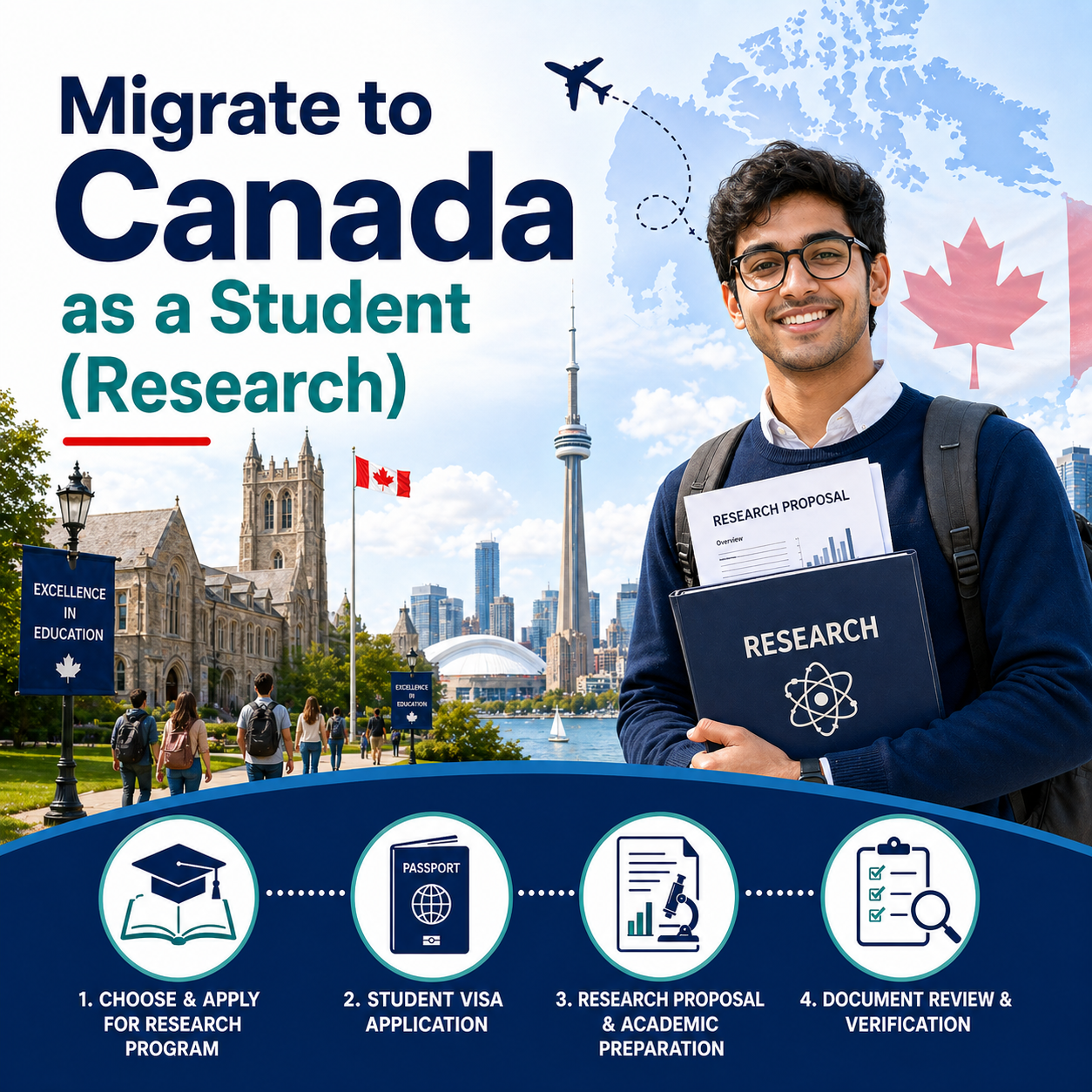
Migrate to Canada as a Student (Research)
This course helps research students plan migration to Canada with confidence through practical structured expert guidance. It covers admission planning, visa requirements, documents, timelines, costs, accommodation, compliance, and arrival preparation. Learners understand key study pathways, application steps, common mistakes, and settlement essentials, enabling them to organise evidence, reduce delays, and make informed decisions before starting their international education journey abroad.
$79.00
Migrate to Canada as a Student — Research Pathway
A practical, step-by-step guidance product for serious applicants who want to study a research master’s, thesis-based master’s, PhD, doctoral programme, or research-focused graduate pathway in Canada — with clear support on supervisor targeting, research proposal planning, DLI checks, study permit preparation, funding evidence, family planning, PGWP awareness, and long-term career strategy.
Important: Do not wait until scholarship deadlines, supervisor availability, study permit processing, or travel dates are close. Research study in Canada can require early topic development, supervisor contact, proposal preparation, university shortlisting, funding evidence, DLI checks, study permit documents, biometrics, medicals where required, family planning, and post-study strategy. Starting late can cost you your intake, funding opportunity, and future options.
Canada can be a powerful research destination — but research applicants need more than a normal study-abroad plan.
Canada offers respected universities, research-intensive institutions, innovation networks, funded graduate opportunities, multicultural communities, and post-study work possibilities for eligible graduates. But research-based study is different from a standard taught programme.
You may need a strong research direction, supervisor alignment, proposal readiness, academic references, funding strategy, DLI and PGWP awareness, proof of funds, study permit evidence, and a clear plan for what happens after graduation. This guidance helps you move with structure instead of guesswork.
Research Pathway Clarity
Understand research master’s, thesis-based master’s, MPhil-style routes, PhD, doctoral study, supervisor fit, and academic progression in Canada.
DLI & PGWP Awareness
Learn why DLI status matters, why PGWP eligibility should be checked before committing, and why research programme choice can affect your future plan.
Study Permit Readiness
Learn what to prepare for your letter of acceptance, proof of funds, study plan, PAL/TAL awareness, biometrics, medicals, and supporting documents.
Action-Focused Guidance
Move from confusion to a practical Canada research study plan with clear next steps and fewer costly mistakes.
Why This Guidance Matters
Many research applicants lose time and money because they begin the Canada study process in the wrong order. Some contact supervisors with weak emails. Some choose universities without checking research fit. Some prepare vague proposals. Some misunderstand funding, DLI status, PGWP eligibility, PAL/TAL rules, family options, or proof of funds.
This guidance gives you a practical overview of what matters most: choosing the right research route, preparing a stronger academic profile, contacting supervisors professionally, understanding study permit requirements, planning finances, and thinking ahead to PGWP, Canadian work experience, and long-term career options.
What This Guide Helps You Do
Get a clear overview of how research planning, supervisor targeting, letter of acceptance, DLI checks, study permit, work rules, PGWP, and post-study planning connect.
Understand research master’s, thesis-based master’s, doctoral programmes, PhD study, research institutes, public institutions, scholarships, and long-term academic direction.
Learn how to think about supervisor fit, faculty alignment, research labs, publications, funding availability, institutional reputation, location, and programme structure.
Learn how transcripts, CV, statement of purpose, research proposal, writing samples, academic references, publications, and English or French evidence can affect your application plan.
Understand the role of your letter of acceptance, proof of funds, study plan, biometrics, medicals where required, Quebec requirements where applicable, and study permit conditions.
Learn why full-time study, research progress, off-campus work limits, co-op or internship permits, spouse work-permit rules, PGWP language requirements, and future skilled-work options matter from the beginning.
Why the Canada Research Route Deserves Serious Attention
- Canada offers respected universities, research labs, innovation centres, government-supported funding opportunities, and globally recognised graduate credentials.
- Research students can use study strategically to build specialist knowledge, academic credibility, publications, professional networks, and future career options.
- Master’s and doctoral applicants at eligible public DLIs may benefit from simplified PAL/TAL rules under current 2026 settings.
- Doctoral students and their family members may benefit from faster study permit processing where official requirements are met.
- Eligible spouses or common-law partners of certain master’s and doctoral students may be able to apply for an open work permit.
- Eligible graduates may later explore PGWP, Canadian work experience, employer opportunities, provincial nomination, Express Entry, or other options depending on their programme, language results, work experience, province, and official requirements.
Who This Is For
Graduates planning a research master’s, thesis-based master’s, or research-focused graduate programme in Canada.
Candidates who need clarity before contacting supervisors, writing proposals, applying for scholarships, or choosing universities.
Applicants who want to understand how early planning, supervisor fit, research strength, academic documents, and timing can affect funding readiness.
Students who want to build a stronger pathway into research, academia, innovation, specialist industry roles, or doctoral progression.
Students who need to understand spouse, children, schooling, proof of funds, accommodation, work-permit options, and long-term affordability.
People who do not want to waste months reading scattered information, contacting supervisors blindly, or preparing documents in the wrong order.
What You Get Inside This Guidance
Your Canada research journey is too important for guesswork.
A weak research proposal, generic supervisor email, missed scholarship deadline, poor study plan, unclear proof of funds, wrong PGWP expectation, or late study permit preparation can damage your plans. This guidance helps you prepare before the pressure begins.
Common Mistakes This Guidance Helps You Avoid
- Choosing a university based only on ranking instead of supervisor fit, research alignment, funding, location, DLI status, and long-term goals.
- Contacting supervisors with weak, generic, or poorly targeted research emails.
- Preparing a vague research proposal that does not show academic direction, feasibility, or fit.
- Missing scholarship, assistantship, supervisor, or graduate admission deadlines.
- Misunderstanding the difference between admission, letter of acceptance, PAL/TAL, study permit approval, and entry to Canada.
- Preparing weak proof of funds, unclear study-purpose evidence, or inconsistent career explanations.
- Assuming every research programme creates the same PGWP, employment, provincial nomination, or permanent residence advantage.
- Ignoring full-time study expectations, off-campus work limits, co-op conditions, programme changes, and study-permit rules.
- Following generic study-abroad advice that does not explain the Canadian research pathway clearly.
This Guidance Is Not For You If…
- You are looking for guaranteed admission, supervisor acceptance, scholarship approval, PAL/TAL exemption, study permit approval, entry to Canada, work rights, PGWP approval, employment, permanent residence, or any immigration outcome.
- You want someone to submit your university, research, scholarship, study permit, PGWP, or immigration application on your behalf.
- You are not willing to prepare documents, compare universities, contact supervisors properly, improve your research direction, check DLI and PGWP relevance, or follow a structured process.
- You want a shortcut instead of a serious Canada research study strategy.
Important Guidance Note
This product provides educational guidance and pathway-planning information only. It does not guarantee university admission, supervisor approval, scholarships, assistantships, PAL/TAL exemption, study permit approval, entry to Canada, work rights, spouse work permit approval, PGWP approval, employment, provincial nomination, permanent residence, or any immigration outcome. For personalised Canadian immigration advice, consult a licensed Canadian immigration lawyer, Regulated Canadian Immigration Consultant, or another authorised professional. For study permit, DLI, PAL/TAL, spouse work permits, work rights, PGWP, and student-condition decisions, always refer directly to official Government of Canada sources and your education provider.
Related Topics
Top related keywords for Migrate to Canada as a Student (Research):
PhD admission pathway
research proposal preparation
supervisor matching
scholarships and funding
Canada study permit
DLI admission
academic references
English language requirements
research ethics and compliance
Post-Graduation Work Permit
international researcher guidance